Completed Special Projects
PROLEAD I: Health Promotion Leadership Training Course in the Western Pacific
Introduction
SEAMEO TROPMED Network , the contractual partner, based in 420/6 Rajvithi Road, Bangkok entered into an Agreement for Performance of Work (APW) with World Health Organization (WHO, WPRO) , UN Avenue, Manila, Philippines (Annex1).
The APW states that WHO will support the work by providing a maximum amount of USD 70,825.00. SEAMEO TROPMED Network was expected to commence the work on 23 March 2004 and be completed by 15 August 2005.
Upon signing of the contract, 50% of the total cost of the APW was paid to the contractual partner.
The detailed statement of the work to be performed is set out below:
- To pilot test the health promotion leadership training programme for national health promotion managers from China, Fiji, Malaysia, Mongolia, Tonga and the Philippines
- To organize three training workshop in July and November 2004 and March 2004 in Manila in coordination with a local training institution and to handle coordination for accommodations, training venues, resource persons, travel and other needs for the training programme
- To develop instruments to help participants assess the relevance and effectiveness of the training programme
- to submit a report on the results of the pilot training and recommendations on how it can be approved
- To disseminate results of this workshop to partners of the health promotion unit and the SEAMEO TROPMED Network.
Accomplishment
1.1. Objective of the Course
The course aimed to equip participants with practical skills across five categories (intra-personal qualities, inter-personal qualities, cognitive skills, communication skills and task specific skills) needed to play sustained, instrumental leadership and management roles with reference to specific challenges of health promotion in the Region. In the end, the participants will be able to pursue a sustained interest to effect significant changes in health promotion strategies in their respective countries.
1.2. Schedule of Modules
The 9-month course on applied leadership and management in health promotion was organized in three separate modules in Manila, Philippines. The first module focused on Leadership and Management organized 26 July- 6 August 2004; second module dealt with Change Management and Organizational Development, 15-26 November 2004; and the third was the Project Presentation last 28-29 March 2005. The detailed schedule for each module is given in Annex 2.
1.3. Participation
A total of 13 fellows from six countries namely China, Fiji, Malaysia, Mongolia, Tonga and the Philippines completed the leadership training. The list of fellows is given in Annex 3.
1.4. Projects
The fellows carried out projects using quality improvement tools introduced during the didactics portion of the course. The projects undertaken aimed to (i) improve an area within the current work context of the fellows; (ii) address a challenge or seize an opportunity; and (iii) advancing health promotion infrastructure and financing in their countries.
The decision to work on certain project was guided by the following:
- project to be conducted should contribute to attainment of national health objective
- project should look into increasing sources of funds for health promotion
- project should look at improving organizational practice and
- project should demonstrate individual leadership and management skills and practices
The projects completed are as follows:
- Development of Health Promotion Foundation in Shanghai, PRC
- Improving Health Promotion Application through Intersectoral Participation in Fiji
- Improving Health Promotion in Mongolia through Good Governance
- Capacity Building for Health Promotion: An On the Job Training Program for the Networking Unit of the National Center for Health Promotion in the Philippines
- Improving “Efficiency and Effectiveness” of Health promotion in Tonga
- Advocacy and Development of Partnership for Malaysian Health Promotion Foundation
Reports of the completed projects were shared during the third module in Manila to WHO, WPRO officials and to the Faculty of the course. Power point presentation of the projects is provided in Annex 4.1.-4.6.
1.5. Evaluation of the Course
A focus group discussion (FGD) was conducted with the participants in addition to an evaluation instruments that they have completed form part of the evaluation of the course.
The FGD findings are summarized below:
- the factors that facilitate learning during the course were the team spirit, interactive process, fellows with different background learning from each other, personality of the fellows, resource persons and invited lecturers, and the topics included in the course
- the project provided the opportunity to apply the learning, reinforced the problem-solving and learning by doing approach, contributed to the capacity building process and to the satisfaction of the fellows
- the curriculum was a good mix of didactics and application, with the field visits providing more opportunities to interact with implementers of health promotion (healthy cities) programme
- fellows feel that PROLEAD can also be applied for a local team (communities, cities)
- PROLEAD can have more impact if undertaken always with WHO even if managed by an academic institution
- the elements of “successful mentoring” are face-to-face communication, involving the mentor right from the start of the course, and mentors should not be perceived to be very busy by fellows
- the duration of nine months was perceived to be just right
- qualities of a person that will benefit more from a PROLEAD type of training include a sense of humour, commitment to health promotion, willingness to learn, with potential to influence and lead changes
- suggestions to include more case studies and extend number of days of the third module
A copy of the evaluation instrument is given as Annex 5
1.6 Recommendations
As the contractual partner of this APW, SEAMEO TROPMED Network recommends the following:
| 1.6.1 | Administration and Logistics
|
| 1.6.2 | Modules
|
| 1.6.3 | In relation to capacity building, a basic course on health promotion is also deemed important to be provided in the region in consideration of the changing roles and functions of health promotion and in keeping with the agenda for health promotion as defined in 2002 by WPRO. |
1.7. Dissemination
SEAMEO TROPMED Network had reported this project in the Southeast Asian Ministers of Education Council Meeting in Hanoi 2005, in the Centre Directors Meeting, July 2005 and included in the Annual Report and Video of the Network for purposes of dissemination.
Course Description
This is a modular 8-month course on applied leadership and management in health promotion designed for health promotion advocates and practitioners in the Western Pacific region. Participants to this course will carry out project(s) using tools introduced during the didactics portion of the workshops that will conducted in three separate modules so as to allow flexibility in training and work schedules.
Objective
The course aims to equip participants with practical skills across five categories (intra-personal qualities, inter-personal qualities, cognitive skills, communication skills and task specific skills) needed to play sustained, instrumental leadership and management roles with reference to specific challenges of health promotion in the Region. In the end, the participants will be able to pursue a sustained interest to effect significant changes in health promotion strategies in their respective countries.
Guiding Principle
- Emphasize applied skills, not just theoretical knowledge.
- Train in a highly interactive manner and draw out personal experience to reinforce team learning.
- Incorporate public health examples to illustrate use of leadership, management and health promotion tools which may originally have been developed in other countries and other sectors; keep examples relevant for audiences.
- Emphasize evidence-based decision-making in health promotion.
- Use applied field projects to 1) reinforce classroom learning, 2) multiply training benefits, and 3) generate products that have a measurable impact on public health program goals.
- Provide post-course mentoring to support health promotion efforts.
- Solicit feedback through a variety of means (e.g., questionnaires, focus groups, external evaluations) and continuously strive to improve the learning process.
Health Promotion Project
It should be made clear to chosen participants that one of the pre-requisites of finishing the course is to do an applied project of their choice. The decision to work on certain project should be guided by the following:
- Project to be conducted should contribute to attainment of national health objective
- Project should look into increasing sources of funds for health promotion
- Project should look at improving organizational practice and
- Project should demonstrate individual leadership and management skills and practices
Conceptual Framework
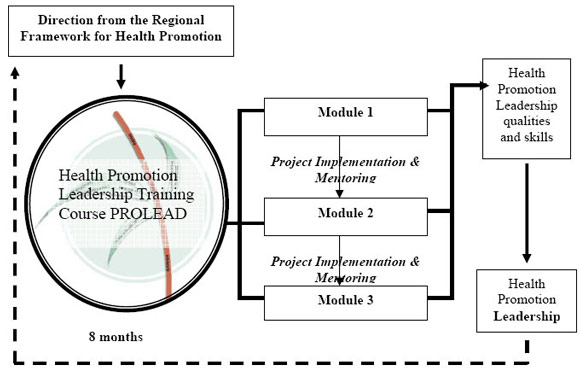
Course Design
PROLEAD is an applied training course that is composed of a series of 3 modules/ with several months interval for project implementation and supervision
The first module covers a range of topics on leadership and management that will help the participants clarify and deepen personal vision and selfactualization; identify priorities and focus energies; recognize problems and assess situations objectively; and realize the effects and impact of working in groups as opposed to working individually. The participants will also be introduced to several topics on health promotion particularly topics on health promotion foundations and legislation. Participants will be asked to present project proposals pertaining to health promotion infrastructure and financing. It is expected that participants will be able to implement their respective project using tools in total quality management and demonstrating leadership qualities as well as skills acquired in communications and coalition-building. Field visits will allow participants to interact with health promotion leaders in healthy city initiative, legislation and population-based marketing. Project implementation phase shall follow. During this time, a faculty/supervisor will visit or constantly communicate with the participant in his/her area to provide supervision. Participants are encouraged to assemble and work in teams.
The second module covers topics on change management and organizational development. Other special topics will also be tackled. This part of the course will include reporting/feedback by the participant of the progress of field projects. Interaction with mentors is expected. Participants will also have the opportunity to participate in the Regional meeting on the economic gains of promoting health scheduled from November 22-26, 2004.
The third and final module will cover oral and poster presentation of the different projects, an evaluation of the course and finally, the graduation of the participants. Policy makers and other health promotion advocates will be invited to witness the shared best practices.
Curriculum Content
Module 1
|
Module 2
|
Module 3
|
Course Leaning Objective
Module 1 (Focusing)
| 1.1 Overview of Health Promotion Leadership |
| Course Objective: |
| To elucidate the scope and range of challenges of health promotion leadership within the context of the regional framework for health promotion |
Cognitive Learning objectives:
|
Behavioural Learning Objectives:
|
| 1.2 Health Promotion Infrastructure and Financing |
Cognitive Learning objectives:
|
Behavioural Learning Objectives:
|
| 1.3 Country Team Reports |
| Course Objective: |
| To provide best practices and strategic options in health promotion from participating countries |
Cognitive Learning objectives:
|
Behavioural Learning Objectives:
|
| 1.4 Personal Insights Profile (Behavioral Style Analysis) |
| Course Objective: |
| To enable participants to identify their particular behavior style with emphasis on improvement of inter-personal relationships |
Cognitive Learning objectives:
|
Behavioural Learning Objectives:
|
| 1.5 Team Building |
| Course Objective: |
| To foster teamwork among participants |
Cognitive Learning objectives:
|
Behavioural Learning Objectives:
|
| 1.6 Effective Leadership (The 7 habits of Highly Effective People) |
| Course Objective: |
| To demonstrate self-mastery and interdependence as essential characteristics of a health promotion leader |
Cognitive Learning objectives:
|
Behavioural Learning Objectives:
|
| 1.7 Health Sector Reform |
| Course Objective: |
| To provide an overview of health sector reform in the Western Pacific Region |
Learning Objectives:
|
Behavioural Objectives:
|
| 1.8 Health Care Financing |
| Course Objective: |
| To provide an overview of health promotion financing models in the Western Pacific region |
Learning Objectives:
|
Behavioural Objectives:
|
| 1.9 Health Promotion and Governance |
| Course Objective: |
| To provide models in governance in health promotion |
Cognitive Learning objectives:
|
Behavioural Learning Objectives:
|
| 1.10 Public-Private Partnerships for Health |
| Course Objective: |
| To provide strategies for effective public-private partnerships |
Cognitive Learning objectives:
|
Behavioural Learning Objectives:
|
| 1.11 Total Quality Management |
| Course Objective: |
| To provide a tool for carrying out health promotion projects |
Cognitive Learning objectives:
|
Behavioural Learning Objectives:
|
| 1.12 Effective Communications |
| Course Objective: |
| To enhance skills in personal and organizational communications |
Cognitive Learning objectives:
|
Behavioural Learning Objectives:
|
| 1.13 Social Mobilization and Advocacy |
| Course Objective: |
| To enable health promotion leaders to achieve mastery in social mobilization processes and techniques |
Cognitive Learning objectives:
|
Behavioural Objectives:
|
| 1.14 Media Relations |
| Course Objective: |
| To foster good media relations to advance priorities in health promotion |
Cognitive Learning objectives:
|
Behavioural Learning Objectives:
|
| 1.15 Negotiation |
| Course Objective: |
| To enable participants to effectively resolve conflict and practice the art and science of negotiation |
Cognitive Learning objectives:
|
Behavioural Learning Objectives:
|
| 1.16 Tobacco Taxes |
| Course Objective: |
| To introduce tobacco taxes as a means to enhance social responsibility for health promotion |
Cognitive Learning objectives:
|
Behavioural Learning Objectives:
|
| 1.17 Other Financing Agreements for Health Promotion |
| Course Objective: |
| To generate interest in forging financing agreements for health promotion |
Cognitive Learning objectives:
|
Behavioural Learning Objectives:
|
| 1.18 Health Promotion Foundations |
| Course Objective: |
| To introduce health promotion foundations to push for reforms in health promotion |
Cognitive Learning objectives:
|
Behavioural Learning Objectives:
|
| 1.19 Health Promotion Legislation |
| Course Objective: |
| To deal with aspects of legislation concerning health promotion |
Cognitive Learning objectives:
|
Behavioural Learning Objectives:
|
Annex 3
| PROLEAD 2004-2005 Regional Health Promotion Leadership Training Pilot Programme |
||||||||||||||||||||||||||
| A collaborative effort of WHO and the SEAMEO TROPMED Network 26 July – 6 August 2004 15-26 November 2004 28-29 March 2005 |
||||||||||||||||||||||||||
|
||||||||||||||||||||||||||
Annex 5
Health Promotion Leadership Training Pilot Programme (PROLEAD)
Dear Prolead fellows,
When we started the course, we emphasized the fact that this is a pilot programme for health promotion leadership training and the fellows are partners in the development process.
We are now in the last leg of this pilot programme but will be soon preparing for a global version of Pro Lead with new countries who are interested in improving health promotion infrastructure and financing.
In order to plan for the future more efficiently and effectively, we need to look back and reflect how we did in the pilot programme
Please feel to share your feelings and insights about the different aspects of the training programme. Be as honest and open as possible as this will be the only way that we can improve the programme. There are no right or wrong answers. All your comments will be carefully considered.
We have provided some space for your comments, but please feel free to use additional pages if necessary.
| 1. | Comment on the objectives of the training programme in terms of its relevance and whether these were met during the implementation. |
| 2. | What are your thoughts in terms of the number, selection process of the fellows. |
| 3. | The training programme was organized into three modules, please comment on the duration of each module and suggest on how best to design the training programme. |
| 4. | Listed below are the topics included for each module. Please share your insights on the 1) relevance of these topics to you; 2) the speakers assigned to the topics and 3) the time allotted for each topic. |
Module 1
|
|
| 5. | Please comment on the training methodology utilized during the three modules. |
| 6. | What can say about the adequateness, applicability, appropriateness of the training materials/references provided? |
| 7. | What are your insights in relation to the project as prerequisite of the course: selection of topic, time allotted to work on the project, logistical and technical support provided for the implementation of the project? |
| 8. | What are your comments on the overall management of the course, venue, secretariat, travel arrangements? |
| 9. | Please comment on the “Mentoring” project with your selected mentors. |
| 10. | Please comment on the “Twinning projects”. What needs to be done to ensure success? |
| 11. | On a personal note, how did this training programme change you as a leader? How has this programme affected your career? |
Prolead II: A Health Governance Initiative
WHO Centre for Health DevelopmentWHO Western Pacific Regional Office
with participation of
WHO Eastern Mediterranean Regional Office
WHO Southeast Asian Regional Office
Module 1: 25 July – 3 August 2005 (Bangkok, Thailand)
Module 2: 5–9 December 2005 (Kobe, Japan)
Module 3: 20–22 April 2006 (Kobe, Japan)
Background
A complex and dynamic global environment requires that public health leadership that must achieve unprecedented levels of collaboration and coordination across programmes and between and among governments and other strategic partners.
Globally, modernization, urbanization, industrialization, environmental degradation, disaster migration, the globalization of markets and telecommunications, and a changing demographic profile have had a profound influence on the social, political and cultural milieu of the world and on health. Health promotion provides social technology to manage these complex social and political processes. Effective and evidence-based health promotion is critical to achieving better health outcomes, more responsive health care systems and greater participation of the community in governance. Capacity building for promoting health across sectors is necessary if people are to increase control over the determinants of health and improve their health status.
In a globalizing environment, new challenges for the promotion of health are becoming increasingly evident as the interaction between globalization and urbanization create new driving forces that impact on health through what is being referred to as “glocalization”1.
In response to these needs and challenges, the WHO Centre for Health Development (WHO Kobe Centre – WKC) and the WHO Western Pacific Regional Office (WPRO) in collaboration with the Southeast Ministers of Education and Tropical Medicine and the School of Public Health, La Trobe, Australia, have agreed to collaborate as proponents for a multi-regional capacity building initiative in support of the global expected results for health promotion2. The initiative seeks to:
| (1) | Delineate priority health promotion leadership development needs and create opportunities for meeting them at the interface between global, national and municipal levels (“the glocal interface”) |
| (2) | Strengthen the evidence base for effective health promotion and use it to inform public health policy development |
| (3) | Provide opportunities to identify mechanisms for promoting health across
programmes, organizations and sectors with specific emphasis on bridging gaps
between national and local health promotion policies, programmes and activities 1 Glocalization is a term that was invented in order to emphasize that the globalization of a product is more likely to succeed when the product or service is adapted specifically to each locality or culture it is marketed in. The term combines the word globalization with localization. (An earlier term for globalization in terms of product preparedness for international marketing is internationalization.) The term first appeared in the late 1980s in articles by Japanese economists in the Harvard Business Review. According to the sociologist Roland Robertson, who is credited with popularizing the term, glocalization describes the tempering effects of local conditions on global pressures. At a 1997 conference on "Globalization and Indigenous Culture," Robertson said that glocalization "means the simultaneity --- the copresence --- of both universalizing and particularizing tendencies." Glocalization was also cited by the Ad Hoc Research Advisory Group of the WHO Centre for Health Development (WHO Kobe Centre) as a potential entry point for the work of the Centre specifically in relation to research on urbanization and health 2 Global expected results for health promotion 2004-2005 include: 1) capability strengthened at national and regional levels for the planning and implementation of multisectoral health promotion policies and programmes across the life course and as populations age; 2) programmes implemented for capacity building for and financing of health promotion at local and community levels, workplace and other settings, with particular focus on improving the health of disadvantaged people; 3) evidence through global review of the effectiveness of health promotion collected and disseminated; and 4) advocacy and health communications strengthened at all levels in relation to health promotion and the major risk factors as defined in The World Health Report 2002. |
| (4) | Connect people, problems and opportunities to develop consensus on the most important determinants of health |
| (5) | Develop setting-specific approaches to address determinants of health, especially among poor, vulnerable and marginalized groups and communities |
| (6) | Ensure sustainable financing and autonomous infrastructure for promoting health at local levels. |
Prolead II: A Health Governance Initiative is a capacity building programme for teams of leaders where teams develop and implement specific action-research projects for sustainable infrastructure and financing for promoting health in their communities.
Introduction
Six teams will participate e.g. India, Japan, Lebanon, Oman, Republic of Korea, Viet Nam and will embark on a capacity building programme for teams of leaders who will address the following issues:
- Lack of understanding of health promotion
- Weak governance for the promotion of health
- Gaps and “tension” between national and local health promotion programmes, policies and actions
- Isolation of health promotion from health sector reform and health systems development and,
- The evolving role of local governments in the promotion of health.
Prolead II: A Health Governance Initiative builds on a leadership development model that started in 2003 in the WHO Western Pacific Region as a collaborative effort between the Southeast Asian Ministers of Education Organization Tropical Medicine Network (SEAMEO TROPMED Network), the School of Public Health of La Trobe University, Australia and the Field Epidemiology Training Program Alumni Foundation Inc., with the support of the Japan Voluntary Contribution.
Course Description
This is a modular nine-month course on applied team leadership and management designed for leaders who promote health. Participants will carry out projects using tools introduced during the didactics portion of the course. This portion will be conducted in three separate modules to allow flexibility in training and work schedules.
The course seeks to build on the experiences of the different Regions of WHO, and will include discussions of case studies from the Global Programme on Health Promotion Effectiveness, the Healthy Cities movement and the Investment for Health Project of WHO EURO.
Opportunities will be created for participants to interact with members of the International Network of Health Promotion Foundations, members of networks from the Healthy Cities movement and other partners who are engaged with health promotion at the glocal interface.
Participants will also participate in a Leaders Forum on Capacity Building for Health Promotion on 4–6 August 2005, and the 6th Global Conference on Health Promotion in Bangkok, Thailand on 7–11 August 2005.
Objective
The course aims to enhance practical skills among teams across five categories (intrapersonal qualities, interpersonal qualities, cognitive skills, communication skills and taskspecific skills) that may be needed to improve governance for health promotion, with a subfocus on new and autonomous structures and sustainable financing to address challenges brought about by glocalization.
Guiding Principle
- Emphasize applied skills, not just theoretical knowledge
- Train in a highly interactive manner and draw out personal experience to reinforce team learning
- Incorporate health promotion effectiveness studies and examples to illustrate use of leadership, management and health promotion tools [Case studies and examples will be selected on the basis of backgrounds, expressed needs and interests of the project teams]
- Encourage strategic thinking in health promotion
- Emphasize governance principles in decision-making
- Use applied field projects to 1) reinforce classroom learning, 2) multiply training benefits and 3) generate products that have a measurable impact on the strategic directions of the participant’s work
- Provide opportunities for mentoring to support professional growth and development
- Solicit feedback through a variety of means (e.g. questionnaires, focus groups, external evaluations) and continuously strive to improve the learning process.
Health Promotional Infrastructure and Finacing Project
One of the prerequisites of finishing the course is an applied project of the participant’s choice.
The project should:
- Contribute to knowledge on bridging gaps between local and national health promotion action
- Address policies related to sustainability of health promotion at the glocal interface
- Result in improved governance and/or organizational practice
- Demonstrate how individual and team leadership skills are applied to specific situations
- Include ‘leverage’ of counterpart funding and cost-sharing at project inception.
Criteria for Selection of Participant
Participants were selected in close consultation with Regional Offices and WHO Representatives of the countries involved.
Teams of three were selected from leaders from local governments, the municipal level health sector, health promotion educators, members of civil society or non-government organizations.
Faculty
WHO Kobe Centre organized a core faculty for composed of experienced international resource persons in health promotion and related fields.
Networking and Mentoring
The School of Public Health, La Trobe University, Australia will serve as the networking and mentoring agent for the project. It will:
- Develop a background paper on research implications for health promotion capacity building
- Facilitate discussions on this background document
- Manage a mentoring and networking component for teams with institutions, organizations, agencies that can enhance their work through mentoring and twinning projects
- Evaluate networking, mentoring and twinning projects
- Prepare an of end-of-project report.
Twinning projects
Capacity building will be further enhanced through ‘twinning projects’ between the country teams and an existing entity (a health promotion foundation, a Healthy City or an equivalent institution) that will undertake highly focused and strategic interventions to advance health promotion infrastructure and financing through international exchange, technical advice and collaboration.
The mechanics for twinning projects will be introduced in Module 1 by the networking and mentoring agent, La Trobe University.
Evalutation
An evaluation design will be built into the programme and will be reviewed at the end of Module 3 in 2006. Regional Advisers for Health Promotion will also be asked to participate in the evaluation process and to assess the applicability of Prolead II to their Region.
Continuity and Support for Future Action
Participants who finish the programme will be part of an alumni network that will continue to provide support to future activities under Prolead.
Course Desgin adn Curriculum
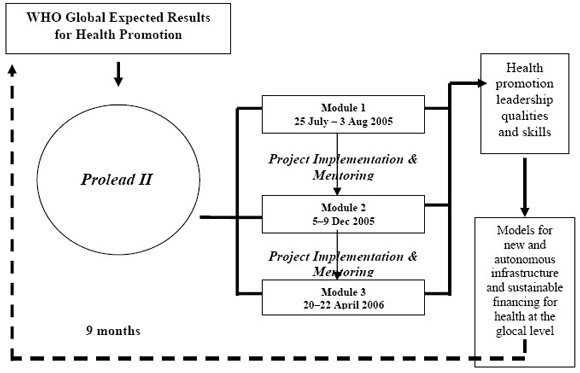
Course Design
Prolead II: A Health Governance Initiative is an applied team-based capacity building course that is composed of a series of three modules with several months’ interval for project implementation and supervision.
Module 1
The first module covers a range of topics on leadership and management that will help the participants clarify and deepen personal vision and self-actualization; identify priorities and focus energies; recognize problems and assess situations objectively; and realize the effects and impact of working in groups as opposed to working individually.
Experienced international resource persons will conduct lectures.
Case study discussions will be conducted using examples from the Global Programme on Health Promotion Effectiveness from different Regions, Healthy Cities, the Health Investment Project of WHO Euro and the work of health promotion foundations.
Participants will also be introduced to principles of multiple sourcing of funding for health promotion. Opportunities will be provided to explore a wide range of options for sustainable financing including dedicated tobacco and alcohol taxation, social health insurance, corporate sponsorships, community financing and more. Public-private partnerships for health and the role of the corporate as well as the non-profit private sector in health promotion will be explored.
A visit to ThaiHealth is included to gain insight into how new and autonomous infrastructure can be achieved.
Project Identification
Participants will be asked to present project proposals on how to achieve new and autonomous health promotion infrastructure and sustainable financing in their locality by addressing specific gaps between national and local health promotion. Participants are expected to implement their projects using the Prolead tools for total quality management and governance. The projects should demonstrate application of leadership skills in communication, advocacy and social mobilization.
Project implementation will cover nine months. Faculty supervisors and mentors will be in constant communication and interaction with the participants. A website facility using Environmentally Sound Technology Information Systems (ESTIS) will be developed and used as a portal for presenting and sharing information about the projects and other initiatives on health promotion from the participants. Participants are encouraged to assemble and work in teams for the duration of the course.
Participation in the 6th Global Conference on Health Promotion
As the first module will be held in Bangkok, participants will also have a chance to participate in the 6th Global Conference on Health Promotion and will be actively engaged in facilitating and sharing experiences on new and autonomous infrastructure and sustainable financing for the promotion of health.
Module 2
At the second module, participants will present progress made in the implementation of their projects. They will also be provided with and opportunity to learn more about models that address glocal health promotion issues such as health promotion foundations, Healthy Cities and public-private partnerships. A special session will also be held on economic arguments for promoting health.
Flexibility is provided in Module 2 to include special topics that will help the participants in their projects. This part of the course will include reporting/feedback by the participant on the status of the field projects. Assessment of the mentoring will take place.
Module 3
The third and final module will cover oral and poster presentation of the different projects, an evaluation of the course and finally, the “graduation” of the participants. Policy-makers and other health promotion advocates will be invited to the course completion ceremony.
CURRICULUM
| 25 July – 3 August 2005 Bangkok, Thailand Module 1 An overview of health promotion infrastructure and financing: a health governance initiative
|
5–9 December 2005 Kobe, Japan Module 2
|
| 20–22 April 2006 Kobe, Japan Module 3
|